Not long after my KH36 arrived in early October 2008 I started thinking about XC handle bars for unicycles. The KH36 is so much fun to ride off road and the longer rides, higher speeds and nature of the 36″ wheel seemed ideally suited to XC style bars of some sort. The arrival of my Schlumpf MUNI Hub a couple of months later – first built into a 29 wheel, then 36 – with its awesome bike like grinding in top gear and high speed reinforced the idea that the front bumper handle wasn’t really enough to control and enjoy the GUNI off road. A good handlebar also makes road riding more comfortable too!

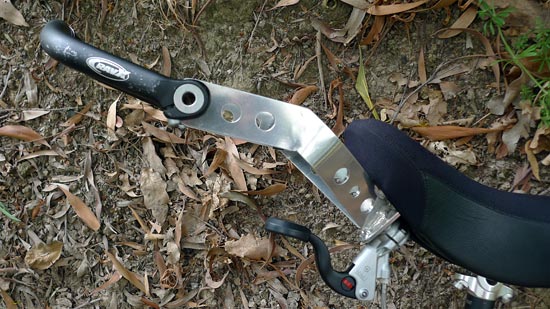
The unicycle handle bars commercially available – the T7 Touring Handle, Coker Pi Bar and more recently the Kris Holm T-Bar Touring Handle – are primarily made for road touring and didn’t meet my requirements for an XC handle bar:
- Retain ability to mount brake lever under front bumper
This is by far my favorite position for braking, which I mainly use when descending rough terrain. I prefer the control offered by gripping the front bumper and braking at the same time, with the same hand vs having a brake mounted away from the seat on the bars. Having the brake mounted under the front bumper also reduces the likelihood of damage to the brake lever assembly during UPD’s. - Seat base mounted, not seat post mounted
Not all riders, especially shorter (me!) & younger riders have seat post to spare on a 36″. Most seat post mounted designs don’t cater for shorter riders, nor do many allow the brake lever to be mounted below the front bumper. Plus I prefer the look of seat mounted bars, and not many seat post mounted bars appear to be UPD friendly – it’s easy to catch body parts on bars during a crash.
- Retain front bumper functionality
The front bumper (or similar functionality) should remain available. Some bars interfere with use of the front bumper, some even make it completely unusable due to a central support tube running close underneath the bumper.
- Uses standard MTB bar ends
Bar ends (versus rigid welded tubes) allow the rider experiment with different bars, adjust position to suit themselves and also provide a weak point during heavy UPD’s, so the bar ends take the impact and bend/break vs the handle bar. The rider can always replace bar ends if they get damaged.
- MTB Rider Position, not Road
Just like MTB generally has a more upright position vs road biking, the bars shouldn’t extend the rider forward excessively but create an open off road riding position. As part of that the bars should also be wider apart than something like a T7 but not so much that they interfere with the rider during UPD’s.
- Sturdy design
The XC handle bar should be sturdy enough to survive UPD’s, which occur more often riding off road on a unicycle vs on road. The handlebar itself should be significantly stronger than the bar ends, such that the bar ends take the impact of crashing and fail first.
- Light weight
The handlebar should be light weight but not so much so that durability is compromised in an unacceptable way, 400-450 grams being the goal. - Ride & UPD friendly
The handlebar shouldn’t interfere with natural riding style. e.g. leg rubbing. It should also be UPD friendly, able to safely pass through the rider’s legs with no sharp edges, protruding bits and pieces etc.
So like other DIY unicyclists the only option was to design and make my own, and as the months have rolled by the GUNI Bar Project has taken shape. It’s been a bit of an obsession TBH!
Back to the Future: History of the XC GUNI Bar
The GUNI Bar started as sketches in my work notepad in November 2008. Lots of sketches but all based around mounting the bars to front four bumper bolts.
Early in the year I finally got started on building the first GUNI Bar. Due to the design I decided to build the bar out of Alu, purchased the tube and plate and prepared the parts at home… using my wood working tools! An Aluminium workshop did the welding. They usually make off road accessories for dirt biking and 4×4 so a unicycle handlebar was well… offbeat!
The first GUNI Bar actually worked out much better than I thought it would. It sat too high which due to the angle also limited access to the faux bumper handle. The basic concept seemed to work well though – no issues hitting the bars with legs and room to use the faux front bumper handle. At less than 300 grams it was also light, too light as it turned out, requiring thick tube to mount the bar ends to.
At this stage it was also clear that a saddle with a plastic seat base wouldn’t be adequate going forward. The handlebar worked but with too much flex – comfortable in a suspension-like way but didn’t inspire confidence under load so I got to work setting up a Carbon Fibre seat base.
The Carbon Fibre seat base was an excellent upgrade – stiff and light. The GUNI Bar really came to life.
Lots of changes were made with MKII – millimetres here and there, thicker material and most of all the bend in the side ‘forks’. Compared to a T7 the forward hand positions were slightly further forward and lower, as well as being further apart, creating a less crowded riding position IMO without being extended too far forward.
After a month or so of riding, crash testing and enjoying the GUNI Bar I began working on plans for MKIII, tidying up a few details, loosing some weight, changing material thicknesses etc. I delivered the plans to the Alu fabrication shop and was just about to head away for holidays when Kris Holm announced a new saddle and stiffener plate (and T Handle Touring Bar – seat mounted!) – great timing as basing the design on a standard seat was a far better option if it was stiff enough. So the project went on hold as the GUNI Bar would most likely need to be modified for the new KH09 seat and stiffener plate.
As luck would have it Unicycle.co.nz received stock of the new seat and stiffener plate in within days of the KH announcement, and by the time I got back from holidays new saddles and stiffener plates were waiting at the post office. Thanks Tony at Unicycle.co.nz!
The MKII handle worked well with the new KH saddle and stiffener plate which was great news. The underside of the seat had been cleaned up a lot and now offered a useful flat mounting area, and more importantly the seat and plate are stiff enough to support the bars – a lot less hassle than a Carbon Fibre seat base for sure. Some changes to the MKIII design would be needed due to altered position of the GUNI Bar when mounted on the new setup, but no worries! A few hours on the drawing board and the revised plans for the MKIII were ready.
The MKIII bar turned out great! It works better, weighs less (~415 grams), and looks better too. One downside is that the handle bar is no longer compatible with the carbon fibre seat base, and that it now requires a Kris Holm 2009 Saddle and Stiffener Plate. The upside is going forward the new KH saddle will be the standard imo.
A good bar should provide a wide variety of hand positions. On the GUNI Bar you can grip the rear cross bar with one hand and be able to brake with one or two fingers, grip either or both of the two side forks, grip the front cross bar with one hand (or fit stuff there like bell, computer, camera etc) and grip one or both of the bar ends in various positions. The front cross bar on the GUNI Bar also provides a relatively protected place to mount accessories like bike computers, bell, lights etc.
I’ve experimented a few different bar ends and busted a few too! The ones I like most ATM are relatively long and run perpendicular to the front cross bar then have the horns that curve in towards each other. I cut them down with a pipe cutter to fit width wise. It’s a bummer that bar ends are no longer fashionable in MTB as it limits the choices available.
It’s a relief to have the GUNI Bar out of my head and developed to a point where the main thing left to do is enjoy riding with it.
If you’re interested in getting a GUNI Bar – WOOHOO! – use the contact form to get in touch with me. If enough people are interested I can do a small run of them.